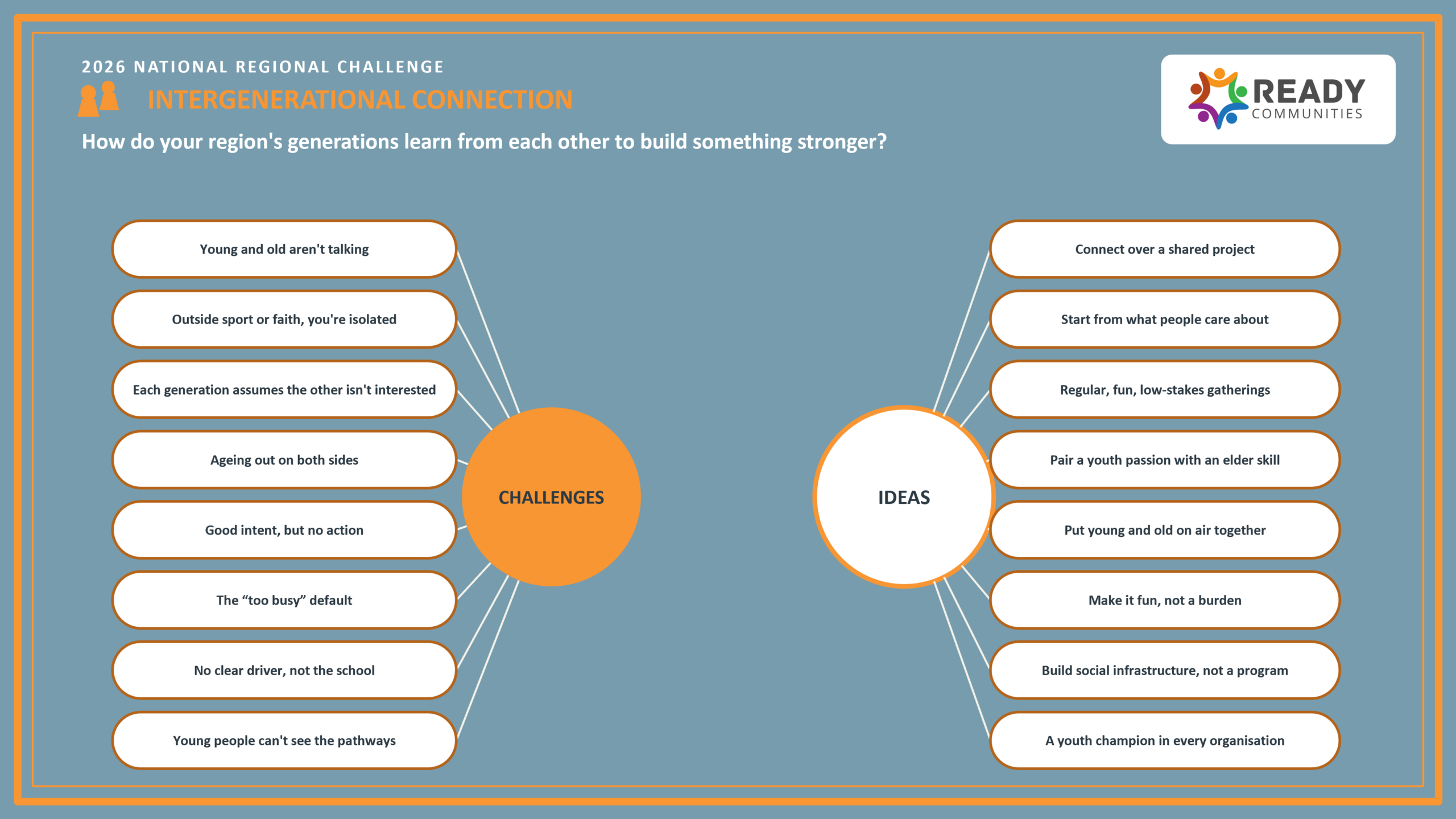
How do your region’s generations learn from each other to build something stronger?
That was the question for the Intergenerational Connection National Regional Challenge conversation. The word “youth” is deliberately omitted from the challenge title to emphasise the connection between generations. This session was different from the others: a smaller, working conversation, more of a planning session for Stanthorpe’s upcoming youth “hackathon” than a broad national panel. It leaned less on cataloguing pressures and more on how to get the generations into the same room.
The National Regional Challenges focus collective attention on the systemic conditions no single organisation, policy, or intervention can shift alone. The six challenges launched in 2026 are drawn from our two-year flagship program in Stanthorpe, Queensland, and each is built to grow national and regional readiness: clearer sight of who’s involved, stronger connections between change-makers, more capability to act, real collaboration for a shared purpose, and advocacy for what works.
The Challenge Engine runs in three stages:
- Inform — gather national case studies, mapping, and virtual sessions, January to September.
- Commit — set shared targets at the Social Impact in the Regions conference in September.
- Act — a cohort of regions run initiatives and report results against those targets.
This post recaps the virtual Intergenerational Connection conversation and what the people in the room raised.
Virtual conversation recap
Challenges
.Young and old are not talking
Both generations are doing great things, but often not with each other.
“We’ve got young people doing great stuff and we’ve got old people doing great stuff as well, but I’m not sure that they’re talking to each other.”
Isolation if not in popular groups
Where sport and church youth groups dominate, young people can feel like they do not fit in.
“If you’re a young person and you’re not involved in sports or your local church youth group, unless you’ve got a huge family, you’re pretty isolated.”
Each generation assumes the other isn’t interested
A perception gap keeps them apart, even though they have more in common than not.
“Young people think older people don’t understand them, and older people feel the same about young people, when in fact they’ve probably got more in common than differences.”
Ageing out on both sides
Young people drift away as senior school and life take over, just as older volunteers step back.
“It’s that whole notion of ageing out on both sides – young people age out when high school and life come along, just like the older generation on the committees and boards.”
Good intent, but no action
The care and commitment are there; turning them into something that happens is the hard part.
“We’ve got the good intent, but we’re struggling to get the action. Why hasn’t this occurred previously?”
The “too busy” default
Proposals stall because everyone is stretched.
“People default to, oh yeah, but I’m too busy, it’s too hard.”
No clear driver, and it can’t be the school
Someone has to carry it, but the obvious host carries a perception cost and is already overloaded.
“I’ve been reluctant for the school to be the driver, because that comes with its own perception of, the school’s doing this again.”
Young people can’t see the pathways
Without visible role models and routes, the young are unsure how to move toward their futures.
“They’re lost about what pathways to pursue, because they can’t see them in their direct line of sight, and lost about how to transition into adulthood.”
Ideas
The ideas converged on a simple insight: connection doesn’t happen in the abstract. Give people something real to do together, make it fun, and build it so the community can keep it going on its own.
Connect over a shared project
Give the generations a concrete reason to be in the same room, and connection follows.
“You need a vehicle for the connection to happen, and that is often project-based.”
Start from what people care about
Find the issues the community cares about, then find who could work on them together.
“Look at the core things people in the region care about, then figure out which groups could come together across the generations.”
Regular, fun, low-stakes gatherings
A recurring, casual event lets big conversations happen off the back of something enjoyable.
“The Monthly Mix Up was a fun event once a month for different generations to connect. The first one had about 70 people from six generations.”
Pair a youth’s passion with an elder’s skill
Match what the young care about with what older people know, and the bond outlasts the project.
“We thought they’d work together for a couple of months; they ended up working together for 18 months, just because that bond was there.”
Put young and old on air together
Use local media to have the generations in conversation, understanding each other on the record.
“If the outcome is simply that old people and young people come together and understand each other better, then that would be a success.”
Make it fun, not a burden
Design for enjoyment first; if people have a good time, they’ll want to do it again.
“We want something where we’re just going to get together and have a good time. Because if we do that, we’re going to want to do it again.”
Build social infrastructure, not a program
Aim for something self-sustaining that no single person or institution has to own.
“You know something’s successful when it occurs and you’ve had nothing to do with it.”
A youth champion in every organisation
Ask each local group to nominate one person to be the bridge to young people.
“If we can get half a dozen people to each say, I’m going to be my organisation’s youth person, the bridge between your organisation and young people.”
Next steps
The National Challenges are informed by the work in Stanthorpe leading into the Social Impact in the Regions conference in September. These virtual sessions test how far local insights are shared by other regions at a national level.
Mapping connects the conversations to the policies and organisations already making progress. Maps will be released in August, ahead of the conference.
Case studies offer aspirational examples of the challenge being addressed and can be submitted through the National Challenge website.
Impact labs at Social Impact in the Regions will focus attention on the target initiatives can carry forward – things like shared-purpose projects, youth in governance, and reasons for young people to stay.
The workshop highlighted challenges and ideas for practice and principles to cross generations. We look forward to hearing what you see working in your community.