
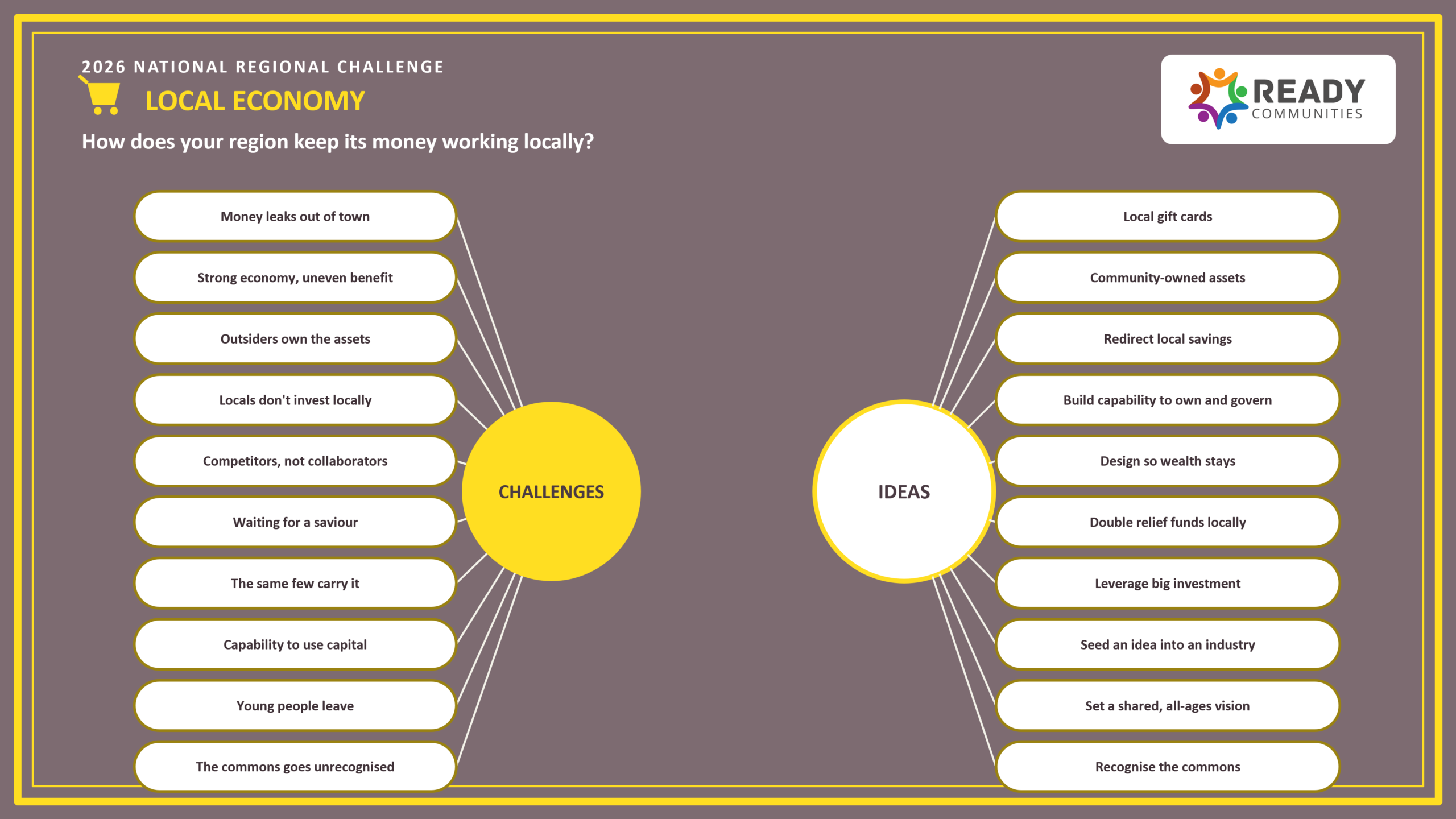
How does your region keep its money working locally?
That was the question for the Local Economy National Regional Challenge conversation. A dollar spent in a regional town can circulate through a dozen local hands, or it can leave in a single tap when it goes to a national chain, an online cart, or an investment outside the region. Keeping money working locally is about who owns the assets, who gets to invest, and whether the value a place creates stays in the place that made it. This conversation drew in community-capital researchers, gift-card and equity-crowdfunding founders, council economic developers, and people building new local industries.
The National Regional Challenges focus collective attention on the systemic conditions no single organisation, policy, or intervention can shift alone. The six challenges launched in 2026 are drawn from our two-year flagship program in Stanthorpe, Queensland, and each is built to grow national and regional readiness: clearer sight of who’s involved, stronger connections between change-makers, more capability to act, real collaboration for a shared purpose, and advocacy for what works.
The Challenge Engine runs in three stages:
- Inform — gather national case studies, mapping, and virtual sessions, January to September.
- Commit — set shared targets at the Social Impact in the Regions conference in September.
- Act — a cohort of regions run initiatives and report results against those targets.
This post recaps the virtual Local Economy conversation and what the people in the room raised.
Virtual conversation recap
Challenges
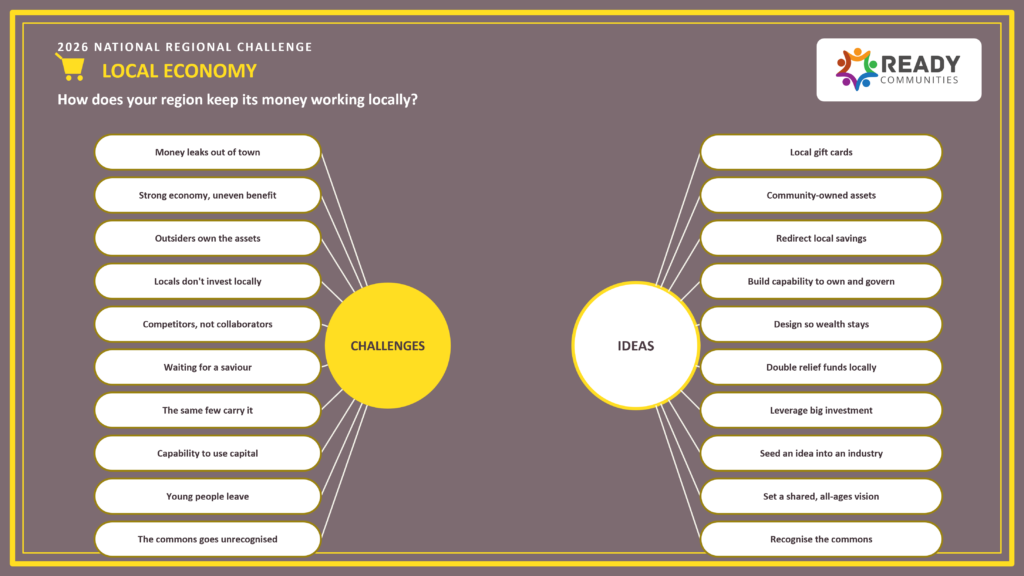
The conversation moved beyond interventions such as “shop local” and community-owned assets to questions of ownership, benefits, and leakage.
Money leaks out of town
Every dollar spent with a national chain or online is a dollar that leaves the local economy.
“Rather than buying a Bunnings or Woolies gift card, you buy one of ours and it stays in local businesses.”
Strong economy, uneven benefit
A busy economy can look healthy while the value it creates never reaches local hands.
“You can have a strong local economy with lots of businesses and investment, but that doesn’t mean the value is translating into local hands, equitably and inclusively.”
Outsiders own the assets
When the assets are owned elsewhere, the economy serves outside interests rather than the people who live there.
“The economy ends up serving the interests of outside parties who own all the assets, rather than the people who live there.”
Locals don’t invest locally
People send their savings to distant markets because it doesn’t occur to them that they could own a piece of their own town.
“People don’t think they can be shareholders in something local, so their super just goes into technology companies in the US.”
Competitors, not collaborators
Local businesses treat each other as rivals, while national and online players capture the real share of local spend.
“Businesses still see each other as the main competitors, rather than the entire global market competing for that share of wallet.”
Waiting for a saviour
Some communities sit back waiting for someone to come and fix it, rather than backing themselves.
“I’ve worked in communities that are waiting for a saviour to come in and do the work for them.”
The same few carry it
A narrow group shows up to everything, and broad buy-in and a shared vision are hard to build.
“It’s the same people that show up to everything. How do you get that broader buy-in and a shared vision?”
Capability to use capital
Keeping money local needs skills and mindset, and some businesses struggle to be aware of, trust, or adopt the tools that would help them.
“Some businesses refuse to pay $150 to be part of the program. They’re set in their minds and won’t change, having no website or social media.”
Young people leave
Young people can move away in search of opportunity and not return, leaving an ageing base.
“All our regional communities are over 60. The young people leave town, and they don’t come back.”
The commons goes unrecognised
The unpaid effort and small not-for-profits that underpin the economy are undervalued and quietly disappearing.
“Small not-for-profits are closing, yet they’re community builders. So much of what enables economic development is unpaid and unrecognised.”
Ideas
Ideas included more than interventions, and placed the focus of community capital on ‘community’.
Local gift cards
A community gift or loyalty card locks spending into local businesses.
“Once the money gets onto that card, people don’t have an option but to spend it in local businesses.”
Community-owned assets
Let the community co-own local assets so the value and agency stays in the community.
“Communities can be co-shareholders in local assets – the value grows and gives back to the community, and it’s retained locally.”
Redirect local savings
Give people a way to put their own long-term savings into a stake in their own town.
“What if a nurse redirected some of her long-term investments into being a shareholder in the local hotel? The dividends go back to local community members.”
Build capability to own and govern
Grow the local capability to generate income, own and govern assets, invest, and redistribute.
“Can our community generate local income, own and govern our assets, invest our own money, and redistribute it back in? Where it can’t, we build that capability.”
Design so wealth stays
Don’t leave it to the market; design the instruments so value flows back to the community by default.
“It doesn’t just leave it up to the market. It’s intentionally designed so the wealth goes back in.”
Double relief funds locally
Route relief and recovery funds through local cards so the same dollar helps twice.
“Rather than giving a farmer $100 cash, you give a gift card, so it goes back into local businesses — double the bang for your buck.”
Leverage big investment
When a large investment lands, attract complementary businesses that leverage off it.
“When we bring in renewable energy, we can attract high-energy-use industries to come alongside, so they leverage off each other.”
Seed an idea into an industry
Back a good local idea with a bit of seed funding, prove it works, and let the industry build around it.
“You build a business, it starts making money, then the infrastructure follows. Start small, stand back, and let the magic happen.”
Set a shared, all-ages vision
Bring the whole community together to picture its future, with the young shaping it as much as the old.
“When does a community come together and say what should we look like in 2030 or 2050 – with 15-year-olds contributing as much as an 80-year-old?”
Recognise the commons
Value and support the unpaid contributions and small organisations that make the economy possible.
“We build community by recognising the different contributions we’re all making – older, younger, all ages.”
Next steps
The National Challenges are informed by the work in Stanthorpe leading into the Social Impact in the Regions conference in September. These virtual sessions test how far local insights are shared by other regions at a national level.
Mapping connects the conversations to the policies and organisations already making progress. Maps will be released in August, ahead of the conference.
Case studies offer aspirational examples of the challenge being addressed and can be submitted through the National Challenge website.
Impact labs at Social Impact in the Regions will focus attention on the target initiatives can carry forward — things like community ownership, shared capital, and local procurement.
The conversation highlighted existing instruments: gift cards, community shares, co-owned assets, and locally governed funds. These need to be made visible and backed with capability. But interventions alone will not stick without underlying conditions and community cohesion. As one participant put it, readiness isn’t a precursor to working together; it’s what happens as we work together. We are keen to hear your stories about what works for community capital in your local economy.