

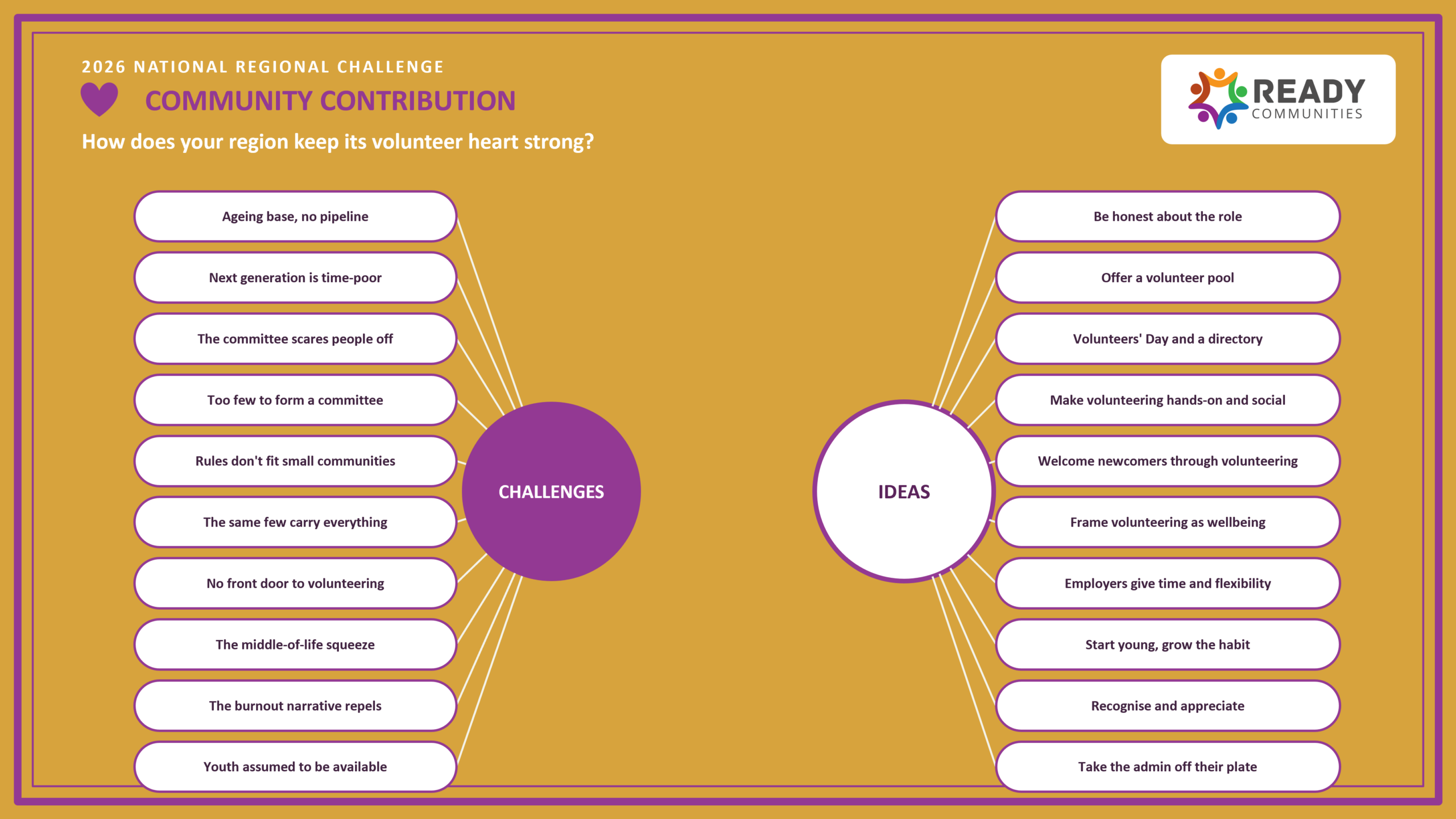
How does your region keep its volunteer heart strong?
That was the question for the Community Contribution National Regional Challenge conversation. Volunteers are essential in a regional town. Volunteers run the radio station, the neighbourhood centre, the show, the Meals on Wheels, and the men’s shed. Volunteering is also facing increased pressures from shrinking and aging populations, families under greater financial pressure, and the word “volunteer” carrying unhelpful connotations of overwork and burnout. The benefits of volunteering for both individuals and their communities go beyond stories about getting more hours from the same people.
The National Regional Challenges focus collective attention on the systemic conditions no single organisation, policy, or intervention can shift alone. The six challenges launched in 2026 are drawn from our two-year flagship program in Stanthorpe, Queensland, and each is built to grow national and regional readiness: clearer sight of who’s involved, stronger connections between change-makers, more capability to act, real collaboration for a shared purpose, and advocacy for what works.
The Challenge Engine runs in three stages:
- Inform — gather national case studies, mapping, and virtual sessions, January to September.
- Commit — set shared targets at the Social Impact in the Regions conference in September.
- Act — a cohort of regions run initiatives and report results against those targets.
This post recaps the virtual Community Contribution conversation and what the people in the room raised.
Virtual conversation recap
Challenges
The people in the room ran neighbourhood centres, volunteer radio, chambers, a school, a council and a national volunteer charity. These were the pressures they named.
Ageing base, no pipeline
Most volunteers fall into the older age group, and there can be a lack of younger people coming through to replace them.
“Most of our volunteers are in that ageing segment. My concern is what we do as our older people are no longer with us, and we’ve got nobody coming through to replace them.”
Next generation is time-poor
The people who could step up are stretched across kids, family and work.
“Getting the next generation to step up is really difficult, because they’re busy with kids and family and work and everything else.”
The committee scares people off
Ask for volunteers, and people can hear “governance” and back away.
“Someone prepared to show up for three days a year hears ‘this group needs volunteers’ and colours that as, does that mean I’m now going to be the treasurer?”
Too few to form a committee
Incorporation rules may require senior roles that smaller populations struggle to fill, placing a strain on the limited number of people with the necessary skills.
“It’s hard to get enough people on the committee so you can actually make decisions, and that in itself wears people out.”
Rules don’t fit small communities
Governance requirements written elsewhere don’t align with the realities of a regional community.
“The structure of committees and the number of people required isn’t appropriate in regional communities.”
The same few carry everything
A handful of people hold every role across every organisation, and they’re tiring.
“It’s the same half a dozen people that are on everything and do most of the volunteering.”
No front door to volunteering
Willing people, with time on their hands, simply can’t find a way in.
“People have heard about projects they’d love to volunteer at, but they can’t find any contact information. They’ve got the time, recently retired, but can’t find the door to enter.”
The middle-of-life squeeze
Career, study, and family crowd volunteering out for those in mid-career stages who have the skills most needed in volunteering roles.
“I would have loved to still do it, but there was give and take – school events, social events, and work commitments.”
The burnout narrative repels
When volunteering is framed as tiring and thankless, newcomers ask why they’d sign up.
“You hear that narrative of volunteer burnout – it’s tiring, it’s old – and people coming into it say, do I want to be part of that?”
Youth assumed to be available
Young people are treated as though they’re free, when many are busy or simply can’t get there due to increasing demands from school, work, and family commitments.
“It’s a misperception that youth aren’t already busy, sitting back gaming 16 hours a day. Many are keen but can’t get there – two parents working, or no one to drive them.”
Ideas
The thread through the ideas was to stop asking people to be everything, and start making it easy to do one clear, worthwhile thing.
Be honest about the role
Name the actual job. The task one person finds dull is exactly what another is looking for.
“The job that in my mind is the most boring thing they’d ever want to do – there are certain people who love it. Be really honest about what you want people to do, and you’ll be surprised.”
Offer a volunteer pool
Keep a database of people happy to help occasionally, with no committee attached.
“A database of people who are happy to volunteer, that various people can tap into at times of need.”
Volunteers’ Day and a directory
Run a sign-up day and a simple public list of who needs volunteers and how to reach them.
“Wodonga has a volunteers day in a park – every organisation looking for volunteers has a marquee and can sign people up on the day.”
Make volunteering hands-on and social
Offer roles where people see the impact on the spot and enjoy the company.
“The food support is real hands-on volunteering. You can see the impact on the spot, and it’s good fun.”
Welcome newcomers through volunteering
Point new arrivals to volunteering straight away as their way into the community.
“If you’re new to town, introduce them to volunteering as soon as they arrive. It’s a great way to meet people and see the benefits.”
Frame volunteering as wellbeing
Position volunteering as good for mental health and connection, closer to social prescribing.
“A lot of people said their volunteering day is their wellness day – one that really helps their mental health and community connection.”
Employers give time and flexibility
Back staff to volunteer through paid time or flexible hours, done carefully so it stays genuine.
“Some businesses get their managers to do so many hours a year. They do it as team bonding, and it creates better culture in the workplace.”
Start young, grow the habit
Get people volunteering as kids, and it sticks. Back it with pathways, such as a school qualification.
“I loved it as a child, and it absolutely inspired me to volunteer later in life.”
Recognise and appreciate
Small, genuine gratitude – a plaque, a gift card, a thank you – keeps people coming back.
“Because we made a bit of money, I gave them a gift card as encouragement. It’s about showing we appreciate you being there.”
Take the admin off their plate
Provide backbone support and tools so volunteers do the work, not the paperwork.
“We provide all the backbone support – the boring bits – through a national bank of volunteers online.”
Next steps
The National Challenges are informed by the work in Stanthorpe leading into the Social Impact in the Regions conference in September. These virtual sessions test how far local insights are shared by other regions at a national level.
Mapping connects the conversations to the policies and organisations already making progress. Maps will be released in August, ahead of the conference.
Case studies offer aspirational examples of the challenge being addressed and can be submitted through the National Challenge website.
Impact labs at Social Impact in the Regions will focus attention on the target initiatives that can carry forward – things like easier onboarding, youth pathways, and shared volunteer coordination across a region.
A region’s volunteer centre keeps the community alive, while it is also important for personal wellbeing. With increased pressures from shrinking and aging populations, greater governance, and competition for time, communities need to find new ways to support volunteer activities. Volunteering is a shared challenge and opportunity in regional Australia, and we are keen to hear what works for you and your community.