
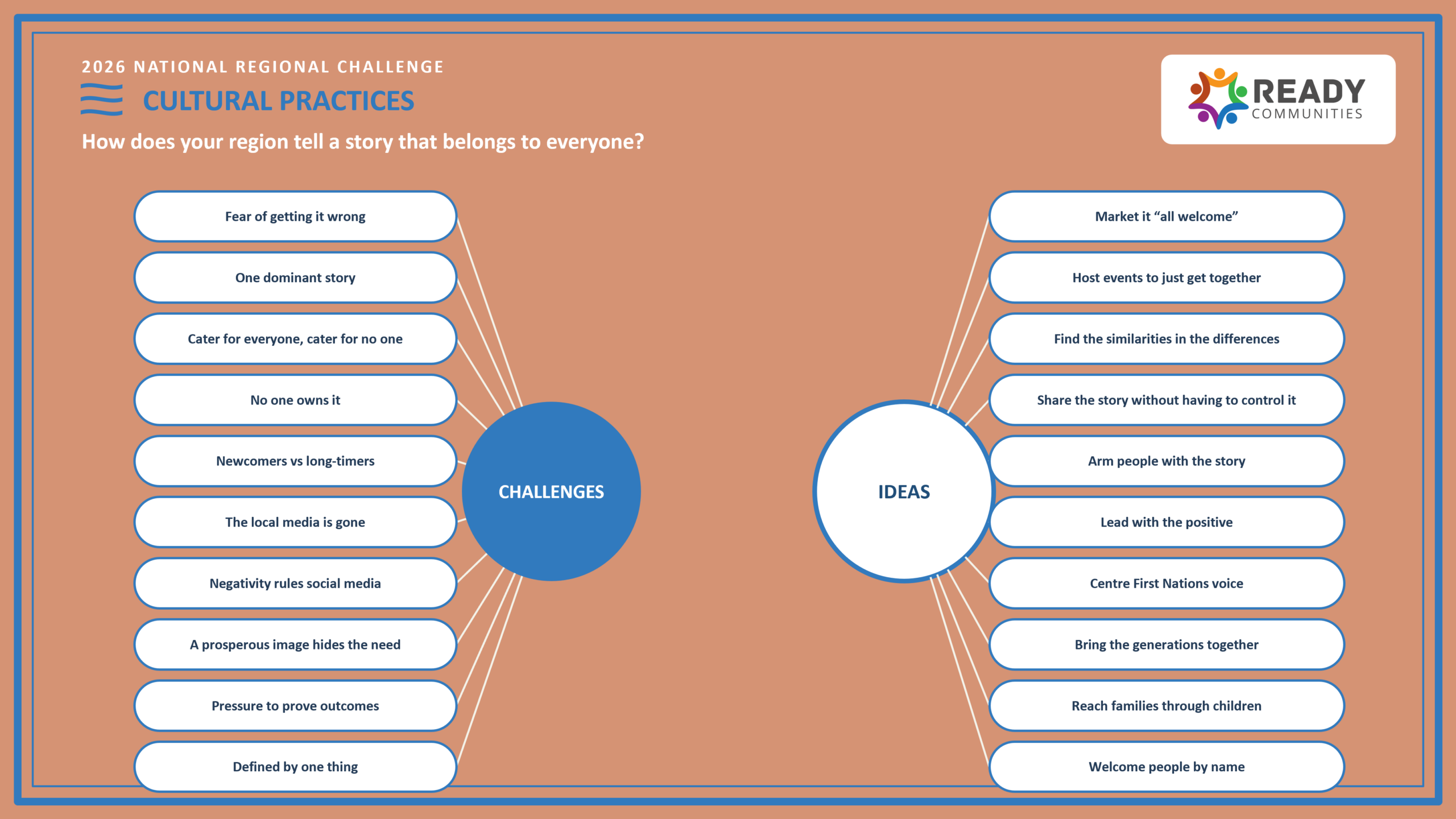
How does your region tell a story that belongs to everyone?
That was the question for the Cultural Practices National Regional Challenge conversations. Every region tells its story through brochures, media, festivals, and Facebook groups. These stories can share a view that may not include everyone, in which one voice is the loudest or one heritage is best known. The local media that used to help carry these stories are mostly gone. The question is whether that story that remains includes everyone it represents.
The National Regional Challenges focus collective attention on the systemic conditions no single organisation, policy, or intervention can shift alone. The six challenges launched in 2026 are drawn from our two-year flagship program in Stanthorpe, Queensland, and each is built to grow national and regional readiness: clearer sight of who’s involved, stronger connections between change-makers, more capability to act, real collaboration for a shared purpose, and advocacy for what works.
The Challenge Engine runs in three stages:
- Inform — gather national case studies, mapping, and virtual sessions, January to September.
- Commit — set shared targets at the Social Impact in the Regions conference in September.
- Act — a cohort of regions run initiatives and report results against those targets.
This post recaps the virtual Cultural Practices conversation and what the people in the room raised.
Virtual conversation recap
Challenges
The theme emerged from community meetings in Stanthorpe, where the arts and the community’s diverse origins kept surfacing together. The virtual session built on these conversations to highlight challenges and ideas below.
Fear of getting it wrong
Developing a story that is to represent everyone can feel high-stakes. People hold back rather than risk getting it wrong, leading to inaction.
“We recognise the importance, so we don’t want to get it wrong. Invariably we aren’t as brave as we could have been, which leads to a lack of action.”
One dominant story
In a diverse community, the loudest or best-known narrative stands in for everyone, and other identities can get left out.
“A lot of people would default to talking about our settlement cultural heritage.”
Cater for everyone, cater for no one
Trying to represent everyone at once can dilute the story until it speaks to no one.
“The correct answer is everyone. But the moment you try to cater for everyone, you risk catering for nobody.”
No one owns it
Because it’s everyone’s job, it becomes no one’s; it slips from committee to committee, and a year goes by.
“Before you know it a year’s gone by, and it’s another committee’s job. I think it’s everybody’s role, and we’re just not doing it as well as we could.”
Newcomers vs long-timers
New arrivals and long-established residents can hold different stories of the same place, and the dissonance keeps them apart.
“There’s a difference between the newcomers coming in and the people who’ve been there a long time, and there can be a bit of a dissonance.”
The local media is gone
The community papers that once carried the shared story are few and far between, leaving no obvious custodian for it.
“My whole career started in community newspapers, and it’s very sad that whole landscape has changed.”
Negativity rules social media
Local Facebook groups reward criticism, drowning out the good that people are trying to do.
“People just want to be critical and see the negative, even when people are trying to do nice things.”
A prosperous image hides the need
A town seen as well-off can miss out on grants and support because of the story it tells about itself.
“Because the image is a prosperous town, we can miss out on some grants, because of the story it’s telling.”
Pressure to prove outcomes
Funders want measurable results, but efforts focused on being together and building trust can be difficult to count.
“The challenge is needing to show outcomes, when for the community the outcome is in being together and trusting each other.”
Defined by one thing
When a community is defined by a single thing, like sport, anyone outside it feels on the outside.
“If you don’t play sport, or participate in the thing that defines the community, all of a sudden you feel like you’re on the outer of everything.”
Ideas
The ideas focused on ways to bring people together.
Market it “all welcome”
Frame cultural events as open to everyone, not aimed at one group.
“The most powerful thing was that it was marketed as all welcome. There’s an opportunity to do something where all cultures are welcome.”
Host events to just get together
Break bread with no agenda. The shared story starts with people simply being in the room together.
“Let’s just get together and have a feed and a yarn – not because you’re different, just get together.”
Find the similarities in the differences
Rather than sort people into ever-finer differences, look for what they share and can work on together.
“Rather than focus on the differences, find out what the similarities are and how we can work together.”
Share the story without having to control it
Co-design the story with the community. The people who help write it become its strongest advocates.
“It’s through people. If you co-design the story, the people who help write it become the biggest advocates and ambassadors.”
Arm people with the story
Give locals a positive, ready-to-tell story so they can carry it themselves.
“We have to arm people with the story for them to tell it.”
Lead with the positive
Accentuate what’s good while staying honest about the challenges. Honey draws people more than vinegar.
“When you picked it up, it just made you feel good… it left those readers wanting to move there.”
Centre First Nations voice
Be intentional about starting with and including First Nations storytelling and art.
“The artwork depicts that this community has many different faces and voices, and sometimes they come together and sometimes they don’t.”
“How do we rewrite a story that’s inclusive to everyone, starting with Country? That’s who we are, and everything else is built on that, including all those industries that shaped the community”
Bring the generations together
Put elders and children in the same room so stories flow both ways.
“The preschoolers going into aged care homes – the elderly have stories to tell, and the young kids have fresh eyes. It’s a powerful way to bring people together.”
“…the original custodians of the land, or the early custodians, through to the people involved in all that land ownership and sharing – if we can all come together and share our stories.”
Reach families through children
Involve youth in the storytelling, as families follow them into community life.
“Families want to be part of community through their children. Working with the children, the parents feel they go along and be part of it.”
Welcome people by name
A persona welcome by name brings outsiders in fast and makes everyone feel seen.
“She read out everyone in attendance and said something interesting about each person. It welcomed us into the community.”
Next steps
The National Challenges are informed by the work in Stanthorpe leading into the Social Impact in the Regions conference in September. These virtual sessions test how far local insights are shared by other regions at a national level.
Mapping connects the conversations to the policies and organisations already making progress. Maps will be released in August, ahead of the conference.
Case studies offer aspirational examples of the challenge being addressed, and can be submitted through the National Challenge website.
Impact labs at Social Impact in the Regions will focus attention on the targets initiatives can carry forward — things like shared vision statements, the voices represented in them, and First Nations inclusion in a community’s story.
A shared story happens when a community keeps getting in the same room, tells the truth about itself, and leaves space at the table for the people who haven’t been asked. Nobody gets it perfectly right, and the fear of that can stop progress. The response includes something as simple as a feed and a yarn, an artwork, a welcome by name. We are keen to hear how your community tells its story, which includes everyone.