

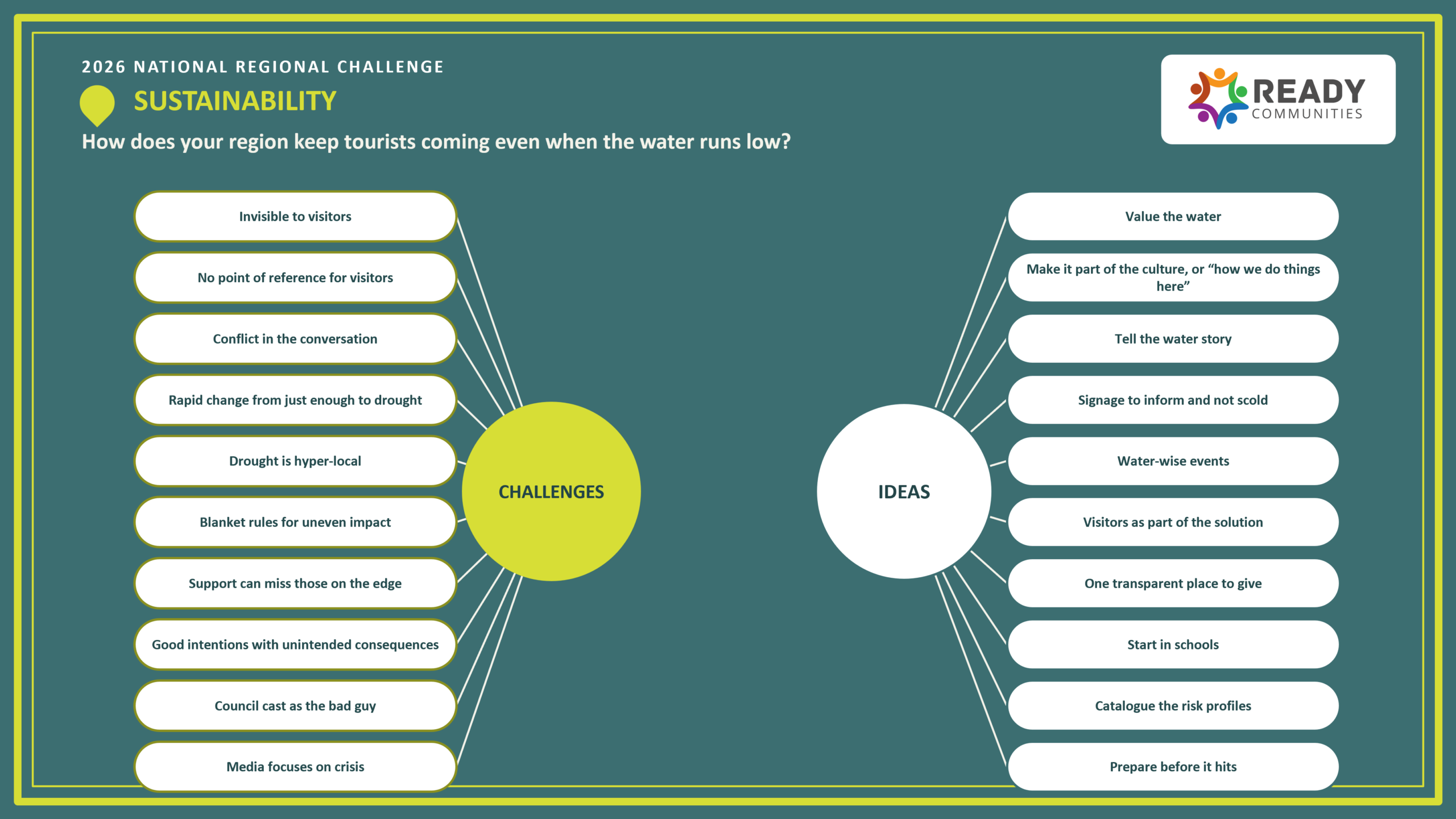
How does your region keep tourists coming even when the water runs low?
We put that question to the Sustainability conversation for the 2026 National Regional Challenges. The connection between drought and tourism offers an opportunity to discuss a multifaceted topic with significant impact on everyone, both within and beyond the region.
The National Regional Challenges focus attention on conditions that require collective efforts more than any single organisation, policy, or intervention. The six challenges launched in 2026 are drawn from the two-year flagship program in Stanthorpe, Queensland. Each challenge is designed to develop national and regional readiness: clarity about who is involved, stronger connections between change-makers, more capability and capacity to act, collaboration for a shared purpose, and advocacy for what works.
The Challenge Engine runs in three stages:
- Inform – gather national case studies, mapping, and virtual sessions, January to September.
- Commit – set shared targets at the Social Impact in the Regions conference in September.
- Act – a cohort of regions run initiatives and report results against those targets.
This post recaps the virtual Sustainability conversation, held at the nexus of drought and tourism, and what the people in the room raised.
Virtual conversation recap
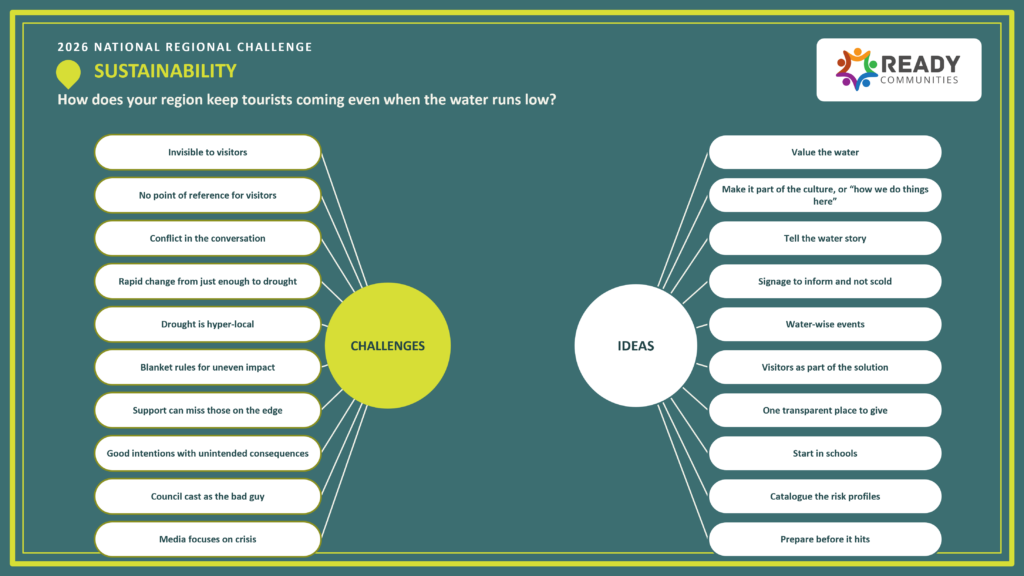
Challenges
Drought is a big topic that involves infrastructure, diversification, social services, and major industry. The conversation focused on the relationship between drought and tourism as an outcome.
Invisible to visitors
One problem is that drought can often be unseen. Nothing on arrival tells a visitor that water is scarce.
“If I didn’t go digging, there’s very little evidence that Stanthorpe runs out of water. There’s nothing to tell me not to crank the hose up.”
No point of reference for visitors
People arrive with abundance in their heads and no reference point for tank water.
“They don’t understand tank water… there’s this idea that my 40-minute shower is part of my tariff.”
Conflict in the conversation
Asking a guest to go easy on water can feel like a confrontation.
“We’re just appealing to people’s common sense, and asking can seem like saying there is a lack of common sense which then feels confrontational rather than being part of the awareness.”
Rapid change from having just enough water to being in drought
“Stanthorpe drops into drought and climbs out of it fast, which can sneak up on locals and outside agencies alike. A little rain resets everyone’s complacency.”
“We go into drought relatively quickly and we come out relatively quickly. It’s the speed that things go up and down.”
Drought is hyper-local
Drought is not experienced the same across the region. One property may have water for its needs, while a neighbour a few kilometres away is in drought, based on both agricultural needs and rainfall.
“You can have some people that are fine, but their neighbour just a few clicks over will be in a deepened drought.”
Blanket rules for uneven impact
A single allocation limit treats every business the same, when their water needs can be very different.
“When there might be a blanket approach to your usage, suddenly that throws some businesses into a pickle straight away.”
Support can miss those on the edge
Relief tends to follow the town grid. The people just outside the grid can fall through.
“Anyone that’s outside of that grid got no tangible support… that’s where some of those really tragic, terrible stories are emerging from.”
Good intentions with unintended consequences
Well-meant help can do harm. A truckload of bottled water or a run of food parcels can undercut the businesses a town is trying to keep, while the intent is appreciated.
“By donating physical goods, it can create a secondary problem.”
“People were sending food packages to farmers who were struggling, but then the local supermarket in that tiny town wasn’t getting the business. It fixed a short-term thing for the farmer, but it created a bigger problem for the retailers, which meant they couldn’t employ more people.”
Council support can be seen as opposition
Restrictions can be seen as an edict from council rather than a shared approach to a community challenge.
“Council are seen as the bad guy rather than people taking the lead and having that shared problem-solving outlook.”
Media focuses on crisis
Media coverage can only highlight the worst-case story.
“What the media wants is drama… there’s a role for leaders in the community to be involved in strategies with media before the crisis.”
Ideas
The conversation about ideas focused on reframing the narrative: avoid blame and emphasise the value of water. Make caring for water how the place does things.
Value the water
Move the conversation from who gets what to what water is worth to the whole community.
“It’s having a conversation around the value of water to our community, so we don’t find ourselves in that polarized debate of who gets a benefit and who doesn’t.”
Make it part of culture, or “how we do things here”
Frame water-consciousness as local culture and good hosting, not guilt, so visitors get a great experience and pick up the local way.
“This is our reality. How do we capitalise on it?”
Tell the water story
Constructive stories, such as how growers cope and what the region has learned, can inform and bring visitors along the journey without fear or shame.
“Storytelling, the ones that are constructive and aim to help us learn, not to make us feel fearful or scared or shamed.”
Signage to inform and not scold
Visible, upbeat signage and simple indicators that tell the water story on arrival and reward awareness rather than punish use.
“Wayfaring signage… ‘it looks great now, but here’s what we’ve gotten down to in times of drought.'”
Water-wise events
Design events and every visit to be water-wise, learning from festivals that already manage it.
“A water-wise event strategy that looks at community and communication, what tourists can do while they’re here, and how they can contribute.”
Visitors as part of the solution
Give visitors a clear, transparent way to contribute and something to take home, so they leave having helped rather than harmed.
“Guests can see or feel good about how they’ve contributed, and the legacy piece they’ve left behind.”
One transparent way give
For people who want to support drought efforts, both during drought and beforehand, provide a trusted, transparent channel.
“I like the idea of having one identified, or a short number of, organisations that might be responsible for receiving gifts of whatever nature, with a transparent strategy of what happens with them. I’d like to see that in this community.”
“If we can find the group that can channel those different types of giving, then drought support where nobody misses out is much more achievable.”
“As soon as those stories about Stanthorpe being in drought are activated, people will want to donate to something. So we need to understand what the governance mechanisms are, particularly in the absence of the drought foundation that had been set up: where should the money flow to now?”
Start in schools
Build the value of water into local education for awareness in young people.
“It’s in education… how it’s integrated into the curriculum so the younger kids, not in a frightening way, learn the value of water.”
Catalogue the risk profiles
Map the handful of distinct water-risk profiles so any response is tested against all of them, not just the loudest voice.
“Do we have a list, say four, five, or eight profiles, of the scenario we need to make sure anything we do accommodates for?”
Prepare before it hits
Treat drought like other crises, such as the cyclone season up north.
“Being prepared for cyclones year in, year out is just a way of life… there’s a role for leaders to be involved in strategies with media before the crisis.”
Next steps
The National Challenges are informed by the work in Stanthorpe leading into the Social Impact in the Regions conference in September. These virtual sessions test how far local insights are shared by other regions at a national level.
Mapping connects the conversations to the policies and organisations already making progress. Maps will be released in August, ahead of the conference.
Case studies offer aspirational examples of the challenge being addressed, and can be submitted through the National Challenge website.
Impact labs at Social Impact in the Regions will focus attention on the targets initiatives can carry forward — things like reducing water use, sustaining tourism through the dry, and measuring what usually goes uncounted.
Drought in regional Australia affects the nation, not just those in the community. It is a shared challenge that requires a collective response.