

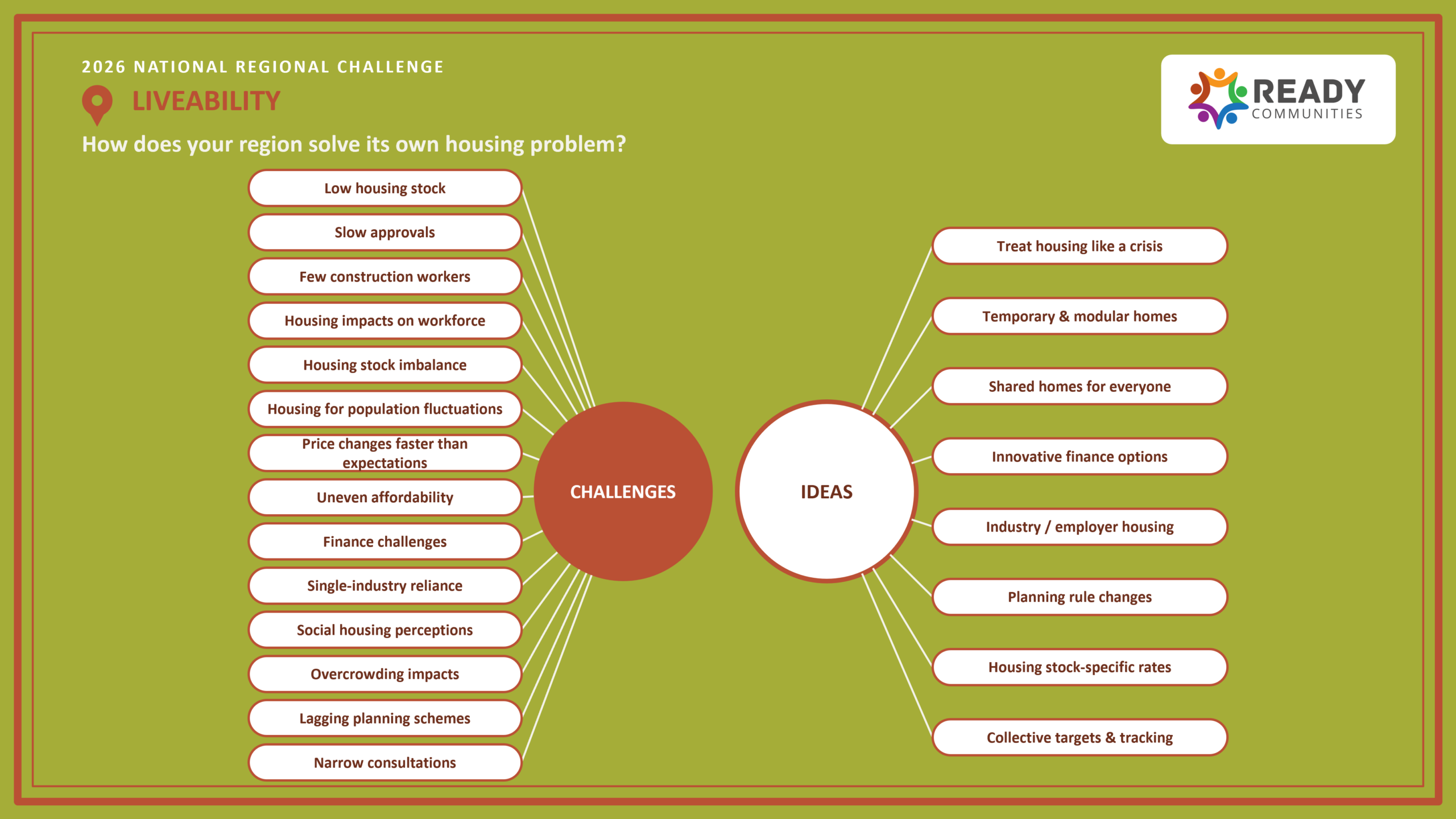
How does your region solve its own housing problem?
We put that question to the first Liveability conversation of the 2026 National Regional Challenges. The conversation highlighted the systemic nature of the housing liveability challenge in regional Australia.
The National Regional Challenges focus attention on conditions that require collective efforts more than any single organisation, policy, or intervention. The six challenges launched in 2026 are drawn from the two-year flagship program in Stanthorpe, Queensland. Each challenge is designed to develop national and regional readiness: clarity about who is involved, stronger connections between change-makers, more capability and capacity to act, collaboration for a shared purpose, and advocacy for what works.
The Challenge Engine runs in three stages:
- Inform – gather national case studies, mapping, and virtual sessions, January to September.
- Commit – set shared targets at the Social Impact in the Regions conference in September.
- Act – a cohort of regions run initiatives and report results against those targets.
This post recaps the virtual Liveability conversation and what the people in the room raised.
Virtual conversation recap
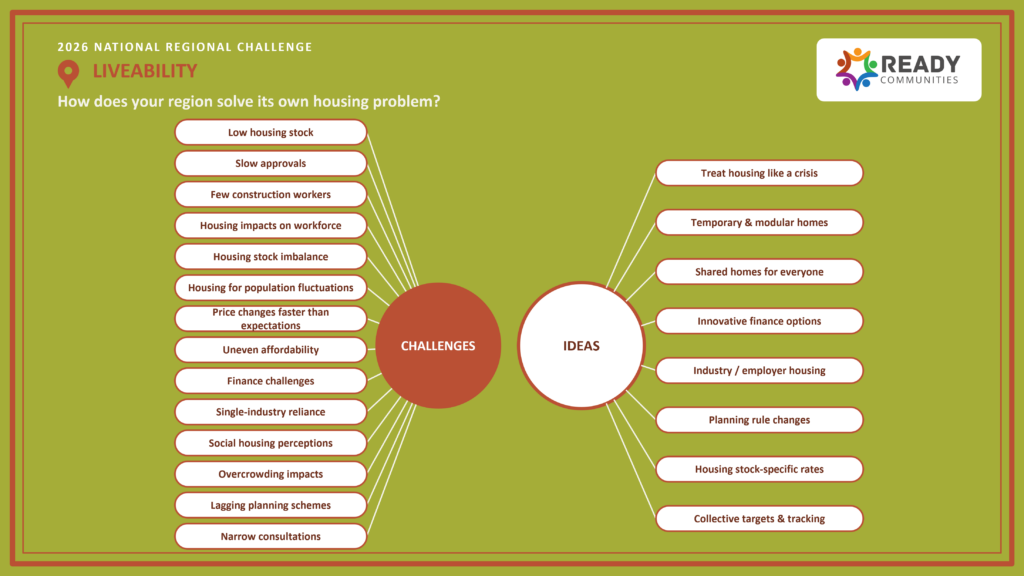
Challenges
The challenge is complex, and not every factor that influences housing was raised. These are the topics that were top of mind for the participants.
Low housing stock
A starting point in the conversation was the limited number of appropriate housing.
“It’s at a stretch, so it’s almost at a crisis point. It’s challenging to recruit workers into the region when housing is slow to achieve.”
Slow approvals
Even if everyone agrees that new housing is needed, approval for new builds can be slow.
“Someone might pull a stat that says our DA-approved houses for the year show X amount of stock coming into the market. But what we find is that it’s excruciatingly slow to actually get it to a concluded state.”
Limited construction workforce
If new housing is approved and scheduled or if housing upgrades are available, getting workers to support the development can be difficult and costly.
“What’s driving that slowness is the issue around accessing adequate or enough trade workers to support the building development.”
Housing impacts on workforce
A lack of housing has impacts on the ability to attract and retain the workforce necessary for health, education, and other essential services.
“If housing’s not available and affordable, my school community struggles to find a place to live. And the harder it is for housing to be affordable and available, the harder it is for me to staff a school.”
Balance of housing stock
A conversation about housing involves balancing different types of housing for short-term accommodation for tourists and transient populations, crisis accommodation, rentals, diverse families, and students.
“Every community is going to have its balance of ephemeral accommodation stock for that transient population, and stayed housing stock for people that live and reside there. But that balance is really quite out of whack.”
Accommodating population fluctuations
While housing often involves permanent structures, the population residing in a community’s housing can fluctuate wildly based on seasonal industry needs and tourism cycles.
“It’s the transient nature of our population. Our community can swell and shrink several times a year given different peak events or just seasonal aspects.”
Price changes faster than expectations
There can be a perception of lower house prices in regional communities that do not match reality.
“What people expect to be available, and what they expect to pay, doesn’t match the reality, even though relative to the metro coastal areas we’re very affordable.”
Housing affordability impacts different age and socio-economic communities
Just as not all housing stock is the same, different groups of people are impacted more based on socio-economic status and family status. This has a compounding effect when regions try to attract early-career populations, typically young families, who may be priced out of the region.
“People are selling up in the metro area for a good figure and coming here because it’s affordable. There are fewer school-aged families for our school community.”
“It is having a disproportionate impact on young families that might be less financially secure.”
Finance challenges
There can be fewer finance options in regional communities. Finance can also be impacted by exposure to climate-affected areas, more likely to be seen in regional communities.
“Some of our smaller towns can’t get finance from banks. If they can’t get the loans, they can’t live there either.”
Single-industry reliance
Housing in regions reliant on a single prominent industry, such as mining, agriculture, or tourism, is expected to be defined by the needs of that industry.
“Because the community is pretty much essentially a mining town these days, accommodation short term and long term is a real issue out there.”
Social housing perceptions
Perceptions versus reality of social housing options need to be considered.
“The local community were up in arms about the development of this social housing project, because they thought it would attract the wrong sort of person to their beachside community.”
Overcrowding impacts
Impacts on community and social structures need to be considered from responses to housing that increase focused population density.
“Overcrowding is another issue, driven by affordability and stock availability, with a flow-on effect on the social and health impacts.”
Lagging planning schemes
The planning system can lag behind the rapidly changing needs of communities and market-driven pressures.
“We’re waiting on the new planning scheme to be formally approved by the state and therefore launched. It’s going from a very archaic version to a very more contemporary version.”
Narrow consultations
Consultations to address housing can neglect wide engagements in the interest of time and cost savings, missing full community perspectives in the input to planning and policy.
“I asked the consultants if they’d spoken to some other businesses and people around accommodation, and they said no. I feel like they’ve actually forgotten about the rest of the story.”
Ideas
With a shared understanding of the challenges, some of the ideas developed include:
Treat housing like a crisis
Many people in regions refer to housing as a crisis, and treating it as a crisis could open up new options across planning and construction.
“Christchurch recreated its town centre with shipping containers so that businesses could trade, and they did that very, very quickly. Because it is a crisis right now.”
Temporary and modular homes as a bridge
Options to explore include looking at temporary and modular homes as longer-term solutions are considered.
“Temporary accommodation, albeit container homes, can be positioned for a temporary period until other land or opportunities get unlocked. Put some parameters around it. It’s not a forever-after solution.”
Shared homes accessible for everyone
When housing is provided, ensure that access is equitable and does not embed conditions of inequality that perpetuate the housing challenge.
“Being able to build something where everyone could live as a collective. It was like a ballot, so everyone had an opportunity to be part of it, rather than who’s got the right money to get in there.” (Reflecting on the example of Nightingale Housing – https://www.nightingalehousing.org/)
Innovative finance options
Explore the expansion of financing options suitable for life conditions.
“If there was some sort of model where they could rent to buy, or a not-for-profit thing like the Good Shepherd does.”
Industry and employer-provided housing
Where employers are able, consider options to secure or create housing that has a shared long-term benefit for community.
“Back in the day when our area had a big timber industry, if a mill opened, the mill would actually build all these houses, and villages arose.”
Planning rule changes
A more rapid and flexible planning scheme to allow for changing demands.
“The new planning scheme does allow for more tiny homes – a relaxing of additional dwellings being able to be built on properties in certain zones.”
Housing stock-specific rates
Applying rates on different housing uses, such as temporary visitor accommodation, to incentivise ownership models.
“It’s an attempt to shake out what might be opportunities for latent housing to be redirected in a different way.”
Next steps
The National Challenges are informed by the work in Stanthorpe leading into the Social Impact in the Regions conference in September. These virtual sessions test how far local insights are shared by other regions at a national level.
Mapping connects the conversations to the policies and organisations already making progress. Maps will be released in August, ahead of the conference.
Case studies offer aspirational examples of the challenge being addressed, and can be submitted through the National Challenge website.
Impact labs at Social Impact in the Regions will focus attention on the indicators and goals that initiatives can carry forward after the conference.
Housing in the regions is more than buildings. It’s about whether a place can attract and retain teachers, its tradies, and its young families. It’s about equity for everyone, not just those who already have access. It’s a basis for stability and liveability on which community can grow. Housing is more than council plans, business investment, or family decisions. The ideas for change are shared with the pressures and impact. We look forward to hearing more about what works in your region with your case studies, feedback, and voice.