


National Regional Challenge

Livability
How does your region solve its own housing problem?
Most of what drives the housing crisis is decided far above the local level. But some communities aren’t waiting. What can a region actually do about its own housing problem?
Inspiring this challenge
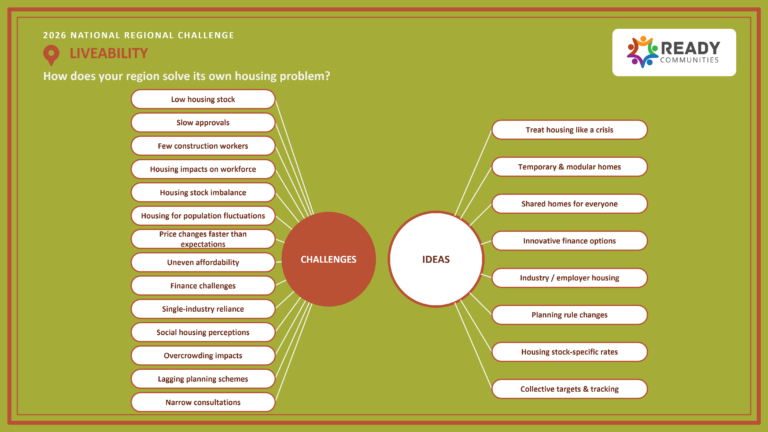
Housing shortage and affordability affect regional communities differently to cities. Workers can’t arrive because there’s nowhere to live. Young people can’t stay because they can’t afford to. People facing housing insecurity have fewer options and less support. And properties withdrawn into short term rental markets reduce the stock available to residents.
The levers that sit nationally and at state level, interest rates, migration settings, planning frameworks, construction workforce supply, are largely outside local control. But matching available workers to available homes, activating under-used stock, coordinating employers and service providers, and holding the local data that makes the case to government are all things communities can organise. The communities doing this are doing something the rest of Australia can earn from.
Practical considerations
Local housing responses require coordination across employers, landlords, councils, and service providers who don’t normally work together. The data needed to make the local case is often held across multiple agencies and hard to assemble. Short term rental pressure plays out differently in every community and regulatory responses sit largely at state level. And the people most affected by housing insecurity, older women, young people, essential workers, are often the least visible in local decision making.
Tell us how your organisation, town or region is addressing this challenge and be part of national action.
Come on Australia – show us yours.
Show australia how your region does it
We’re looking for Communities, councils, employers, and housing providers that have organised a local response to housing pressure and are willing to share what they learned. Tell us how:
- You’ve matched workers to available housing by bringing employers, landlords, and service providers together.
- You’ve activated under-used housing stock and got it into long term supply.
- You’ve built the local data and advocacy that made your housing situation visible to the people with the power to help.
- You’ve found a way to manage short term rental pressure without undermining your visitor economy.
- You tried something, it didn’t work, and you know exactly why.

